Auschwitz-Birkenau Memorial and Museum
Visiting Auschwitz-Birkenau is unlike visiting any other historical site. It is not a museum in the usual sense, nor simply a collection of buildings, barracks and ruins. It is a preserved landscape of a crime committed on an industrial scale, a place where over one million people – the vast majority of them Jewish – were murdered. Today the Memorial exists for three connected reasons: remembrance, education and warning.
If this is your first time reading about Auschwitz, you might expect the story to begin with the gas chambers and crematoria. But the origins of the camp start earlier, with an ordinary Polish town, a railway junction and the Nazi occupation of Poland in September 1939. Understanding this beginning helps make sense of how Auschwitz expanded into the largest German Nazi concentration and extermination camp.
The town of Oświęcim before the war
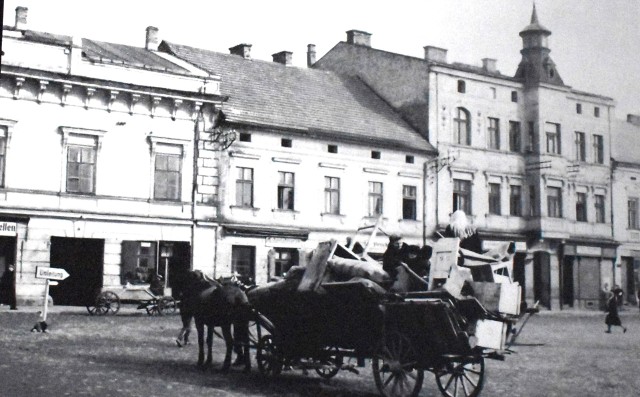
Before the Nazi invasion, Oświęcim (German: Auschwitz) was a mid-sized Polish town on the Sola and Vistula rivers. It had a population of around fourteen thousand people, with a Jewish community that made up roughly half of the residents. The town had synagogues and churches, bakeries and small factories, market stalls and family homes – in short, the normal texture of everyday life.
Nothing about the town itself suggested it would become the centre of the largest killing site in Europe. What changed everything was location. Oświęcim sat on an important railway junction linking Upper Silesia with Kraków, Vienna, Katowice, Prague and beyond. For the German occupiers – obsessed with logistics and the movement of people and goods – this made the area strategically valuable.
After the German invasion of Poland in September 1939, the town was annexed directly into the Third Reich. Many of its Polish and Jewish residents were expelled, resettled or pushed into ghettos elsewhere. Their homes and workshops were taken over for military and administrative use. German authorities soon began looking for locations in the region where they could expand their network of concentration camps.
Why Auschwitz was chosen
The decision to establish a concentration camp in Oświęcim was made in early 1940. Several features made the location attractive from the German perspective:
- Existing military barracks – A former Polish Army artillery complex on the edge of town provided ready-made brick buildings. These became the core of the first camp, later called Auschwitz I.
- Railway access – Auschwitz sat at the intersection of key railway lines. As deportations expanded later in the war, trains could arrive from Holland, France, Italy, Greece, Hungary and across occupied Poland with relative ease.
- Room to expand – The surrounding region offered large areas of flat land, ideal for constructing the much larger camp that would become Birkenau (Auschwitz II).
- Proximity to industry – The IG Farben chemical complex (Buna) planned nearby required tens of thousands of forced labourers. The camp could supply them.
At first the camp was not designed primarily as an extermination site. Its initial purpose was to imprison and terrorise Polish political prisoners: teachers, priests, resistance members, civil servants and anyone seen as a potential leader of an uprising. The first transport of Polish prisoners arrived on 14 June 1940 – a date still marked in commemorations today.
Auschwitz I – the original camp
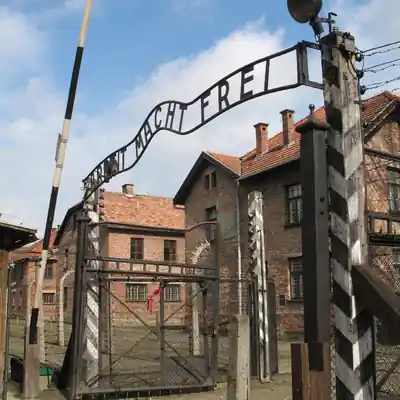
Auschwitz I is the brick-built site you see in many of the best-known historical photographs: the “Arbeit macht frei” gate, the rows of two-storey barracks, the guard towers, the commandant’s house and administrative buildings. Although much smaller than Birkenau, Auschwitz I served as the administrative and experimental centre of the entire Auschwitz complex.
Life inside Auschwitz I
Conditions in Auschwitz I were brutal from the beginning. Prisoners were crammed into overcrowded barracks, often sleeping on straw or wooden planks with little protection from heat or cold. Food rations were deliberately inadequate. Daily roll calls could last for hours in all weather. Punishments, both formal and informal, were frequent and severe.
Block 11, sometimes called the “death block”, contained punishment cells, including standing cells where several prisoners were forced to stand for hours or days in a space barely larger than a cupboard. Starvation cells and cells used for executions were also located here. In the courtyard between Blocks 10 and 11 you can see the reconstructed Death Wall, where thousands of Polish political prisoners were shot.
Experiments and terror
Several barracks in Auschwitz I housed medical and pseudo-scientific experiments. These ranged from studies on infectious diseases to attempts at forced sterilisation and racial “research” aligned with Nazi ideology. Prisoners were used as unwilling test subjects, often with fatal or permanent consequences.
One of the most terrible developments in Auschwitz I was the testing of Zyklon B, a cyanide-based pesticide, as a method of killing humans. Early experiments in the basement of Block 11 in 1941 would later be scaled up in dedicated gas chambers in Birkenau, turning Auschwitz into a major centre of mass extermination.
For most of the camp’s existence, the commandant was Rudolf Höss. His postwar testimony at the Nuremberg trials and later in Poland became an important – though not unproblematic – source for historians reconstructing how the camp operated.
The creation of Birkenau (Auschwitz II)
By late 1941, the SS had begun constructing a vastly larger camp a few kilometres away from Auschwitz I. This new site, built on the land of the village of Brzezinka (German: Birkenau), was initially intended to hold tens of thousands of Soviet prisoners of war. It soon evolved into the main centre of mass extermination in the entire Auschwitz complex.
Birkenau eventually covered over 170 hectares. It contained hundreds of wooden and brick barracks, four large crematoria with attached gas chambers, numerous guard towers and double electric fences, latrine and washing blocks, administrative zones and a railway line running into the heart of the camp. If Auschwitz I was the administrative brain, Birkenau became the killing centre.
The layout of Birkenau
To help you picture what you will see during a visit, it helps to know that Birkenau was divided into a series of sectors, each with a particular purpose:
- BI – Initially a men’s camp, later largely for women prisoners.
- BII – Several sub-sectors, including men’s barracks, quarantine areas and hospital blocks.
- BIIe – the “Gypsy camp” – A segregated area where Roma and Sinti families were held together.
- BIIb – the “family camp” for Czech Jews – A separate sector where deportees from Theresienstadt were kept for a time before being murdered.
- BIII “Mexico” – A planned extension of the camp, only partially completed.
- “Canada” – The nickname prisoners gave to the warehouse area where belongings of murdered victims were sorted and stored; “Canada” suggested abundance and plenty in prisoner slang.
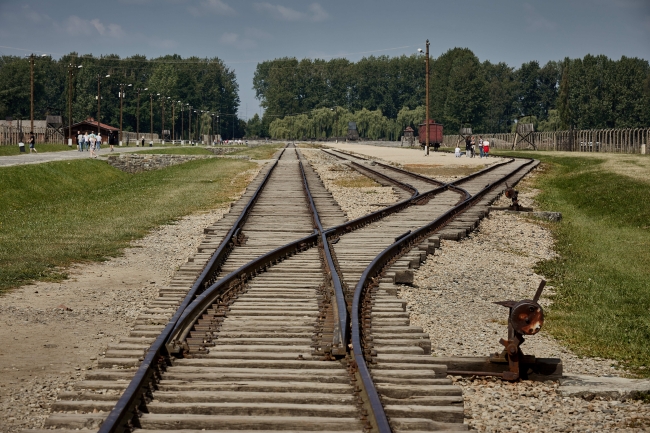
From the main guardhouse at Birkenau, the railway tracks run directly into the camp along a straight line. This is the ramp where many of the most infamous photographs of arrivals and selections were taken.
Arrivals, selections and separation
Most people sent to Auschwitz-Birkenau arrived by train, often in sealed freight wagons without proper food, water or sanitation. Journeys could last days. When the train finally stopped and the doors were opened, deportees were pushed out onto the ramp, dazzled by floodlights at night or by sudden daylight.
On the rail ramp, SS doctors and guards carried out rapid “selections”. Within minutes they divided new arrivals into two groups:
- Those deemed “fit for work” were sent into the camp as registered prisoners.
- Everyone else – the elderly, the sick, pregnant women, most mothers with young children – were sent directly to the gas chambers.
There was deliberate deception at every stage. Signs pointed towards “baths” and “disinfection”. People were told to remember where they left their clothes, to tie their shoes together, or to keep certain documents with them. All of this helped maintain the illusion that they were simply being processed for labour, making the process easier for the perpetrators to control.
Families were often separated on the ramp in seconds – men to one side, women and children to another. For many, this moment was the last time they saw their loved ones.
The gas chambers and crematoria
Birkenau contained four large crematoria complexes – numbered II, III, IV and V – as well as earlier killing facilities converted from former farmhouses, known as Bunker 1 and Bunker 2. Crematoria II and III were partly underground buildings, with changing rooms and gas chambers below, and furnace rooms above. Crematoria IV and V were single-level structures, built differently but serving the same purpose.
Victims directed to the gas chambers were ordered to undress in underground or adjacent rooms. They were instructed to tie their shoes together, hang their clothes and remember the number of their coat hook. Many believed they were going to showers. Once the rooms were full, guards sealed the doors and pellets of Zyklon B were introduced through openings in the ceiling or via side hatches. The gas released cyanide, killing those inside within minutes.
Afterwards, Sonderkommando prisoners – themselves held under terrible conditions – were forced to ventilate the rooms, remove the bodies, cut hair, extract gold teeth under SS supervision and operate the furnaces. Their existence is one of the most disturbing aspects of Birkenau’s operation, as they were compelled to participate in the machinery of murder under constant threat of death.
As the war turned against Germany, the SS attempted to destroy evidence of the killings. Crematoria II and III were blown up in January 1945; the ruins that visitors see today are the collapsed remains of these structures. Crematoria IV and V were also damaged and dismantled. Despite these efforts, enough survived – alongside documents, photographs and testimonies – to prove what happened beyond doubt.
Who were the victims?
Over 1.3 million people were deported to Auschwitz during its existence. Historians estimate that at least 1.1 million of them were murdered. The camp’s victims came from across Nazi-occupied Europe.
Jewish victims
The overwhelming majority of those killed at Auschwitz were Jews. They arrived from Poland, Hungary, the Netherlands, Greece, France, Czechoslovakia, Belgium, Germany, Italy and other countries. In many deportations – such as those from Hungary in 1944 – the majority of arrivals were murdered in the gas chambers on the day they reached Birkenau.
Roma and Sinti
Roma and Sinti (often referred to as “Gypsies” in historical sources) were held in a special family camp in Birkenau. Entire extended families, including children, were imprisoned together. On the night of 2–3 August 1944, almost all remaining prisoners in this camp were murdered in the gas chambers. Today this date is commemorated as Roma Genocide Remembrance Day.
Polish political prisoners
Polish political prisoners made up the earliest large group of inmates. Many of the iconic striped uniforms and early registration photographs you see in the museum exhibitions show Polish men and women: teachers, students, clergy, doctors, civil servants and members of the underground resistance.
Soviet prisoners of war and others
Soviet prisoners of war were also held and murdered in significant numbers, particularly in the early phase of the camp. Other victims included non-Jewish prisoners from across Europe – resistance members, Jehovah’s Witnesses, homosexual prisoners, and people labelled “asocial” or “criminal” by Nazi authorities.
Resistance and survival
Despite the extreme brutality of camp life, Auschwitz was not without resistance. Prisoners from different nationalities and backgrounds created underground networks that shared information, kept up morale, sabotaged work and sometimes assisted escape attempts.
The Sonderkommando revolt
One of the most remarkable acts of resistance occurred in October 1944, when Sonderkommando prisoners organised a revolt. Using gunpowder smuggled from a nearby munitions factory by women prisoners working there, they blew up Crematorium IV and attempted a broader uprising. The revolt was quickly suppressed and many participants were killed, but the act remains a powerful symbol of defiance in unimaginable conditions.
The Witold Pilecki mission
Another extraordinary story is that of Witold Pilecki, a Polish resistance officer who deliberately allowed himself to be arrested during a German roundup in order to infiltrate Auschwitz. Once inside, he built an underground network, gathered information and sent reports about conditions in the camp to the Polish government-in-exile. He eventually escaped in 1943. His mission provided some of the earliest detailed eyewitness accounts of the camp to the outside world.
Everyday acts of solidarity
Alongside these dramatic episodes were countless small acts of solidarity: sharing bread, giving away a pair of shoes, passing on a message, offering a word of encouragement, or quietly taking over a sick prisoner’s work assignment. In a system designed to destroy human dignity, such acts were a form of resistance in themselves.
The last phase: death marches and liberation
As the Soviet Army advanced in late 1944 and early 1945, the Germans began evacuating camps in the east. In January 1945, tens of thousands of prisoners were forced to leave Auschwitz on foot in so-called “death marches” towards the west. Ill-clothed, underfed and exhausted, many died from cold or hunger or were shot by guards along the way.
On 27 January 1945, Soviet troops entered Auschwitz. They found around seven thousand prisoners left in the camp – people who had been too weak or ill to join the marches. The soldiers also discovered evidence of the killings: abandoned suitcases, hundreds of thousands of items of clothing, tons of human hair packed in sacks, and the ruins of the crematoria. Today, 27 January is marked internationally as Holocaust Memorial Day.
After liberation: preserving memory and evidence
The transformation of Auschwitz from a place of murder into a memorial and museum was not immediate. In the first months, Soviet and Polish investigators documented the site, collected German documents, and interviewed survivors. Local residents began to return to the surrounding area, while some former prisoners helped safeguard the grounds.
In 1947, the Polish parliament formally established the Auschwitz-Birkenau State Museum. Its task was to preserve both Auschwitz I and Auschwitz II-Birkenau as historical evidence and as a place of remembrance. Survivors played a crucial role in shaping how the site should be presented to future generations: not as a spectacle, but as a warning.
Many of the original belongings found in warehouses – shoes, suitcases with names and addresses, prayer shawls, kitchen pots, children’s clothes – became part of the exhibitions. Thousands of registration photographs taken by the SS, showing prisoners shortly after their arrival, were preserved. These images are among the most haunting parts of a visit: individual faces, each with a name, number and story, standing against the anonymity imposed by the camp.
What you will see during a modern visit
Visiting Auschwitz is emotionally demanding, but knowing in advance what you are likely to encounter can help you move through the site respectfully and at a pace that suits you.
Auschwitz I today
In Auschwitz I you walk through the original brick barracks, many of which now contain exhibitions. You see the “Arbeit macht frei” gate at the entrance, rows of buildings, internal streets, gallows, the reconstructed Death Wall and the remains of the first gas chamber and crematorium.
The main exhibitions include:
- Blocks that explain the history of the camp and the wider German occupation of Poland.
- Rooms filled with belongings of victims – shoes, suitcases, household items – arranged in quiet, overwhelming displays.
- Corridors of registration photographs showing Polish prisoners in striped uniforms, with the dates of their arrival and death.
- Blocks dedicated to particular national groups or themes.
The information here is dense. Many visitors find that they can only absorb part of it in a single visit, and that is completely normal. It is not necessary to read every panel; it is enough to move slowly, pause where something particularly speaks to you, and remember that you can always return in the future.
Birkenau today
Birkenau is very different in atmosphere. It feels wide open and exposed, with long views across the remains of wooden barracks, brick chimneys, guard towers and fences. From the main gate you can look down the rail line towards the ruins of the crematoria and the international memorial at the far end.
As you walk through Birkenau, you may encounter:
- Rows of chimneys marking where wooden barracks once stood.
- Surviving barracks that give a sense of the cramped, cold and unsanitary conditions prisoners endured.
- Latrine and washing blocks, stark reminders of how basic hygiene was almost impossible to maintain.
- The ruins of the gas chambers and crematoria, with collapsed concrete and exposed brick structures.
- Memorial plaques in many languages, bearing the names of countries from which victims were deported.
The sheer scale of Birkenau is often what stays with visitors. It makes visible the industrial nature of the killing and the vast number of people who passed through the camp.
Why ruins and objects matter
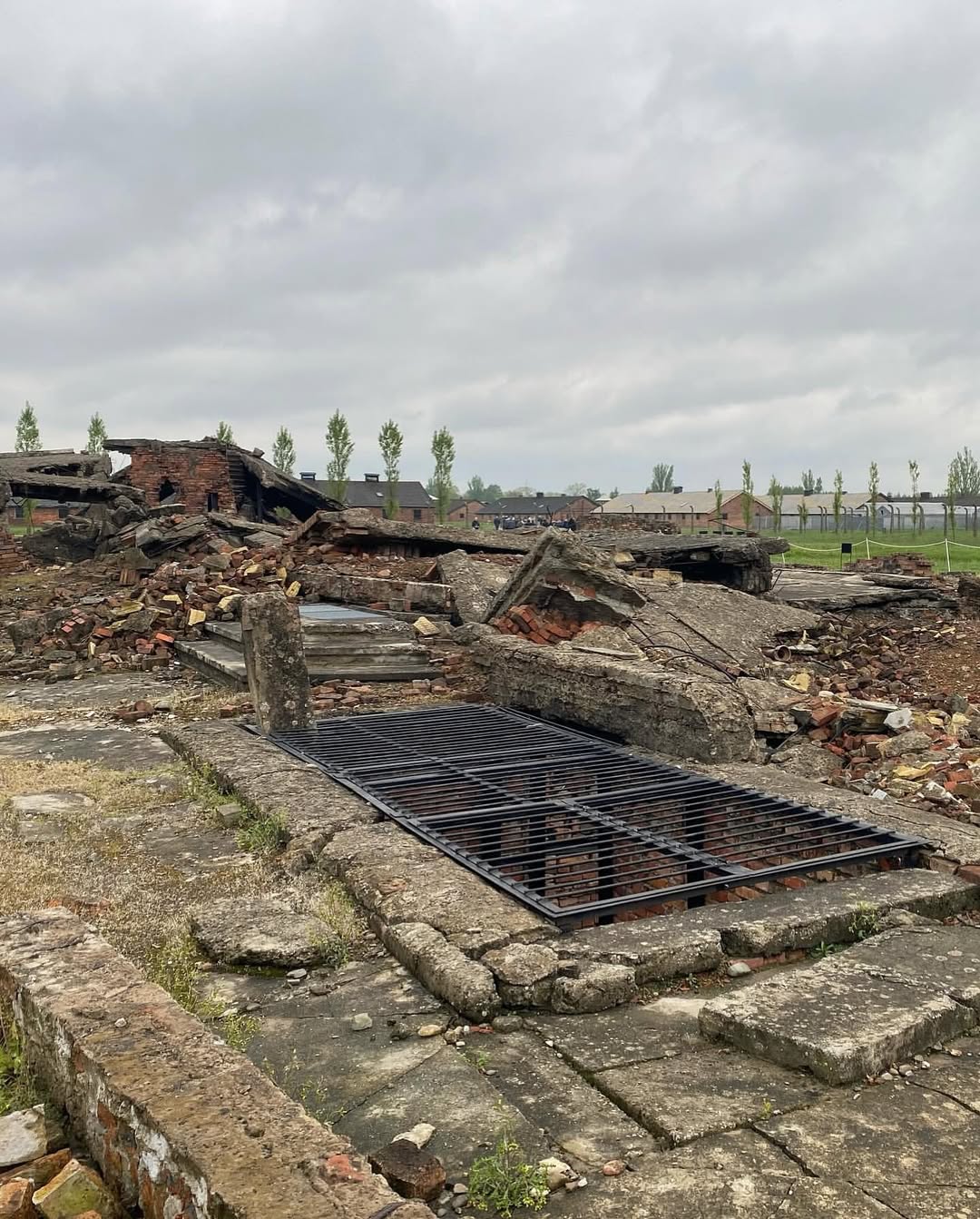
In many parts of Birkenau you see only foundations, collapsed roofs or isolated chimneys. This is not a failure of preservation. These ruins are themselves important evidence of what once stood and of the attempt to destroy trace of the crime.
Inside the exhibitions at Auschwitz I, by contrast, you encounter carefully preserved objects: piles of shoes, suitcases with names painted on them, children’s clothes, hairbrushes, prayer shawls. Each item belonged to a person who once packed a suitcase, locked a front door, hugged a relative goodbye, perhaps still believing they were being taken to resettlement rather than to murder.
Walking through the site connects documents, photographs and testimonies to a physical place. It becomes harder to think of the victims as anonymous numbers, and easier to understand that each number represents a life as complex as our own.
Emotional responses and how to approach your visit
There is no “correct” way to feel at Auschwitz. Some visitors experience deep sadness or anger; others feel numb or strangely distant, as if their mind has not yet caught up with what they are seeing. Many find it difficult to put their reactions into words.
What matters most is respect: speaking quietly, avoiding photographs in sensitive areas where they are discouraged, not treating the visit as a spectacle or a simple item to tick off a list. It can be helpful to build in time afterwards to sit quietly, walk in nature, talk with your travelling companions or simply be alone with your thoughts.
During a hosted visit, your driver or host is there not only for practicalities but also if you have questions, need a moment to pause or want to understand better how a particular place fits into the wider story of the camp.
Common questions and difficult thoughts
Many visitors leave Auschwitz with questions that are moral as well as historical. Here are a few that often arise:
“Why didn’t people fight back?”
Some did – in extraordinary ways – but the camp system was designed to make organised resistance almost impossible. Starvation, exhaustion, beatings, constant surveillance, random punishments and deliberate deception all worked together to crush the possibility of rebellion. That resistance existed at all, from underground networks to the Sonderkommando revolt, is remarkable.
“Did the outside world know what was happening?”
Information did reach Allied governments during the war, through reports from escapees, resistance groups and diplomats. Some details were dismissed as exaggerated because the scale of the crime was difficult to grasp. Even where governments believed the reports, turning knowledge into effective action proved complicated and, in many cases, tragically slow.
“Why preserve such a painful place?”
Many survivors insisted that Auschwitz and similar sites should be preserved precisely because they are painful. Without the physical evidence, it would be easier for future generations to deny or minimise what happened. The Memorial stands as a warning of what can occur when racism, antisemitism and totalitarian power go unchecked.
Auschwitz within a wider journey
For visitors based in Kraków, Auschwitz-Birkenau is often part of a wider exploration of wartime history: the former Płaszów camp on the edge of the city, Schindler’s Factory museum, the area of the wartime ghetto in Podgórze, and sometimes more specialised routes further afield such as Project Riese or Stalag Luft III.
Seen together, these places help you understand not only the mechanisms of extermination, but also the broader system of occupation, forced labour and everyday life under Nazi rule. They show how decisions made in Berlin translated into changes in a single Polish street, a factory floor, a hillside quarry or a railway siding.
Further reading and survivor voices
A single visit can only ever be an introduction. Many guests choose to explore more through survivor memoirs and testimonies. Books by authors such as Primo Levi, Elie Wiesel, Viktor Frankl, Tadeusz Borowski and others offer personal perspectives that no exhibition panel can fully capture.
Listening to those who lived through Auschwitz – in their own words – is one of the most powerful ways to honour their experience and ensure that the history remains more than a set of dates and numbers.
Continuing your exploration
Whether you read this page before your trip, on the evening before your visit or afterwards as you process what you have seen, remember that you do not need to memorise names or statistics for the visit to be meaningful. Simply arriving with a basic sense of how Auschwitz began, how it expanded and who its victims were will help you recognise places and stories once you are on site.
When you are ready, you can return to the history guide to explore other locations, or go to the tours page to see how Auschwitz-Birkenau can fit into a wider route that matches your time in Poland and your interests.