Schindler's Factory and Kraków's wartime ghetto
When people hear the name "Schindler's Factory", many immediately think of the film Schindler's List: black-and-white images of Kraków streets, a girl in a red coat, a list of names and a factory owner who becomes an unlikely rescuer. The real history behind those images is richer, more complex and closely tied to the everyday life of occupied Kraków.
Today, Oskar Schindler's former enamelware factory on Lipowa Street houses one of Poland's most powerful museums about the Second World War. Its exhibitions are not just about Schindler himself, but about the whole experience of the city under Nazi occupation: the invasion, terror, resistance, the creation and liquidation of the Jewish ghetto and the transfer of people to the Płaszów camp and beyond.
A short distance away, on the other side of the river in Podgórze, you can walk through the former ghetto district, stand among the empty chairs in Ghetto Heroes' Square and see fragments of the original ghetto wall. These places, taken together, make the story of occupation in Kraków feel immediate and real.
This page offers a calm, visitor-friendly overview of how Schindler's Factory and the wartime ghetto fit together. You do not need to learn everything in detail. Think of it as a primer: a way to have key names, places and dates in mind so that when you step into the museum or onto the streets of Podgórze, what you see makes more sense.
Kraków at the outbreak of war

On the eve of war, Kraków was a major Polish city with a rich intellectual and cultural life. The Old Town and Wawel Castle formed the historic core, while districts such as Kazimierz and Podgórze had strong local identities. The Jewish community played a significant role in trade, crafts and professional life. Streets that tourists stroll down today were full of shops, workshops, cafés and market stalls.
Germany invaded Poland on 1 September 1939. Within weeks, Kraków was occupied and soon chosen as the capital of the new General Government – the civilian colonial administration that would rule much of occupied central Poland. The German leadership in Kraków saw the city both as a prestige location and as a laboratory for their policies.
Occupation changed everyday life quickly. New laws restricted movement, imposed curfews and targeted Jewish residents. Polish institutions were dismantled or taken over. The city administration, police and railways fell under German control. For Jews in particular, the noose tightened steadily: identification, registration, forced labour and finally segregation into a ghetto.
The creation of the Kraków ghetto in Podgórze

In March 1941, the German authorities created a Jewish ghetto on the right bank of the Vistula, in the district of Podgórze. This choice was practical and symbolic: Podgórze was then a more industrial, working-class area with suitable streets and squares, but it also allowed the authorities to remove Jews from the prestigious Old Town and Kazimierz districts.
To form the ghetto, thousands of Jews from across Kraków were ordered to move into a compact walled area of just a few streets. Non-Jewish residents living inside the designated zone had to leave. Around eighteen thousand people were crammed into an area that had previously housed much fewer, leading to extreme overcrowding.
High walls, topped in places with arches shaped like tombstones, enclosed the ghetto. Gates controlled who could enter and leave. Within the walls, daily life continued as best it could: children went to makeshift schools, workshops produced goods for the German war economy, religious and cultural life adapted in reduced form. But food was scarce, conditions were harsh and the constant threat of deportation hung over everyone.
Today, parts of these ghetto walls still survive in Podgórze. On a modern visit, you may see short preserved sections, baked into the midst of newer buildings. Knowing what they once enclosed gives these unassuming strips of masonry a very different weight.
Oskar Schindler and his factory on Lipowa Street

Oskar Schindler was a Sudeten German businessman and member of the Nazi Party who arrived in Kraków shortly after the occupation began. He saw opportunity in the rapid restructuring of the economy and in the availability of seized Jewish businesses.
In 1939 he took over a defunct enamelware factory at 4 Lipowa Street, in the Zabłocie industrial district, on the left bank of the river. He renamed it Deutsche Emailwarenfabrik (DEF) and reoriented its production towards goods for the German military – mess tins, cooking equipment and later shell casings.
At first, Schindler's motives were essentially commercial. He needed cheap, reliable labour and found it by employing Jewish workers – people who, under the occupation's racial laws, could be paid less and controlled more tightly than Polish or German staff. His connections to the German military and the SS helped him secure contracts and protect his business.
Over time, however, the balance between profit and protection shifted. As the situation for Jews in Kraków worsened, having a job at Schindler's factory became, for some, a lifeline. A work permit there could mean the difference between deportation and temporary reprieve. Schindler used this leverage increasingly to shield his workers, bribing officials, falsifying documents and arguing that specific individuals were essential for production.
The ghetto liquidations and the move to Płaszów
The Kraków ghetto was not a static place. Over time, it was reduced in size and population through deportations to extermination camps such as Bełżec and, later, Auschwitz. In March 1943, the Germans carried out the brutal liquidation of the remaining ghetto. Many inhabitants were shot on the spot or in nearby locations; others were sent to the newly expanded forced labour and concentration camp of Płaszów.
These events – particularly the chaos and violence of the liquidation – form some of the most harrowing scenes in Schindler's List. While the film compresses and dramatises certain aspects, the basic reality of people being driven from their homes, separated and killed is grounded in survivor testimonies.
After the liquidation, Jewish workers with permits for factories like Schindler's were registered through Płaszów. Many now lived in the camp and were marched to work, or lodged in satellite barracks connected to their workplaces. The lines between ghetto, camp and factory became blurred: all were elements of a single system.
Schindler's gradual transformation
Within this system, Schindler's role evolved. He remained a businessman who enjoyed good food, parties and material comforts. He also grew increasingly protective of his Jewish workforce. Survivor accounts describe him intervening personally to save workers from transport lists, arguing with officials, and using gifts and bribes to secure exemptions.
As deportations intensified, Schindler made a radical move. He proposed relocating his factory and workforce to a new site in Brünnlitz (Brněnec) in occupied Czechoslovakia, away from the direct control of Płaszów and from the mass murder centres in occupied Poland. To make this happen, he created lists of workers who were to be transferred – the famous "Schindler's list" of film and book.
The real process was messy, bureaucratic and fraught with danger. Not everyone whose name was intended for the list ended up on it in the same way, and there were moments when transports were misdirected or people nearly sent to Auschwitz instead. But the transfer saved around 1,200 Jews, who survived the war as Schindler's workers in Brünnlitz.
Today, when you walk through the museum at Lipowa Street, you see not only Schindler's story, but also those of the many unnamed people whose lives intersected with his factory, both Jewish and non-Jewish, across the spectrum from opportunism and collaboration to resistance and rescue.
The factory museum today – what you will see

Schindler's former enamelware factory now houses a permanent exhibition titled "Kraków under Nazi Occupation 1939–1945". While Schindler features in the narrative, the museum's focus is wider: it tells the story of the city as a whole during the war.
As you move through the exhibition, you pass through a series of immersive rooms and corridors that use photographs, original objects, recreated interiors, soundscapes and film to convey what life felt like for different groups of residents. Sections typically include:
- The invasion and early occupation – How German rule was established, how institutions were taken over and how daily life began to change.
- Anti-Jewish measures – Laws, signs, restrictions and propaganda that progressively excluded Jews from public life.
- The Kraków ghetto – Crowded rooms, narrow streets and documents that show how people adapted to life within the walls.
- Forced labour and the war economy – Factories, workshops and offices where Poles and Jews worked under increasing pressure.
- Resistance and underground life – Secret printing presses, coded messages, and acts of sabotage and aid.
- Deportations and camps – Photographs, transport lists and testimonies tracing the route from Kraków to Płaszów, Auschwitz and other camps.
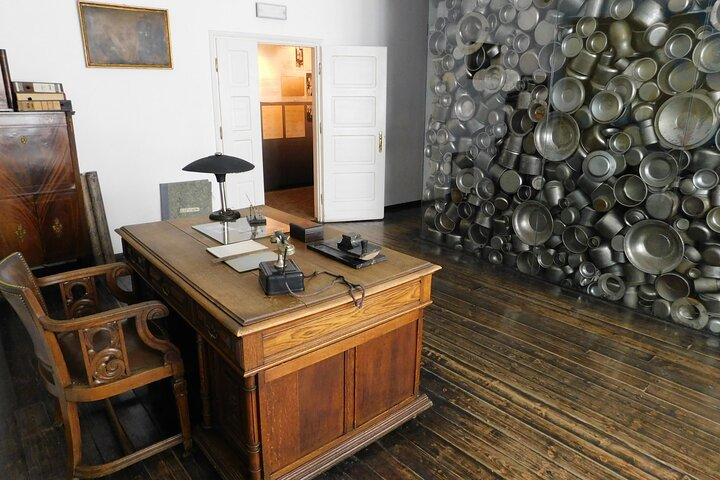
- Schindler's office – The preserved office with his original desk, often one of the most striking points for visitors.
The museum can feel busy, especially in peak season, but the route is well signposted and you can move at your own pace. Many visitors find it helpful to take short pauses in quieter corners to absorb what they have seen before continuing.
Practical impressions: atmosphere, pacing and accessibility
Unlike open-air sites such as Płaszów, the factory museum is mostly indoors. This means you visit in all weather and throughout the year. The atmosphere is more controlled: lighting, sound and design are used intentionally to guide your experience. Some rooms are darker, some louder, some more intimate. If you ever feel overwhelmed, you can simply step aside and let others pass.
Text panels are generally available in Polish and English, with audio guides or guided tours offering additional context. A hosted visit can be especially useful if you prefer to have the key points highlighted, or if you want to connect what you see here with your visit to Auschwitz or other sites.
Because of the amount of information and sensory detail, many guests find that about two hours inside the museum is enough for a first visit. You do not have to read every label. Focusing on the broad storyline and a handful of individual stories can be more meaningful than trying to absorb every fact.
Ghetto Heroes' Square – an empty chairs memorial

From the factory, it is a short drive or tram ride across the river to the heart of the former ghetto in Podgórze. The central space here today is Ghetto Heroes' Square – a broad, open plaza where you will see dozens of large, empty metal chairs scattered across the cobbles.
This memorial, designed by Piotr Lewicki and Kazimierz Łatak and unveiled in 2005, symbolises both presence and absence. Each chair stands for the people who waited in the square during deportation actions, often told to bring their belongings and wait for "resettlement", not knowing that many would be sent to death camps or to Płaszów. The chairs are oversized enough that you can sit on them, but they are also stark and minimal, leaving plenty of space around them for thought.
Around the square, plaques mark buildings that once housed ghetto institutions such as the pharmacy "Pod Orłem" (Under the Eagle), whose Polish owner Tadeusz Pankiewicz and his staff secretly assisted Jewish residents. Several of these sites now contain small museums or exhibitions.
Fragments of the ghetto wall and everyday streets
Not far from Ghetto Heroes' Square, in residential streets, you can find preserved sections of the original ghetto wall. Unlike the huge, continuous walls that some imagine, these were modest-height masonry structures with characteristic arched tops, reminiscent of Jewish tombstones – a design choice that added symbolic humiliation to practical segregation.
Today, these wall fragments stand quietly between apartment blocks and garages. A simple plaque explains what they once delineated. Standing beside them, you may find it helpful to imagine children going to school on one side and none on the other, or someone leaning against the bricks to catch a breath during a long day of work details.
Walking the surrounding streets of Podgórze gives you a sense of scale. The ghetto was not huge; it was a handful of blocks, packed with thousands of people. Many buildings still carry the same facades they did before and during the war, even if the shops and occupants have changed.
Film locations and the "world of Schindler's List"

When Steven Spielberg came to Kraków to make Schindler's List, he chose to use real city streets wherever possible. Many scenes set in the ghetto were filmed not in Podgórze itself – which had changed significantly since the war – but in the historic district of Kazimierz, whose pre-war architecture remained closer to the period look he needed.
This means that the "world of Schindler's List" is spread across several districts: Kazimierz, Podgórze, the area around the factory and the hills that echo Płaszów. Recognising a doorway or a street corner from the film can be a striking moment, but it is useful to remember that the film is an interpretation. It condenses time, combines characters and uses visual metaphors – such as the girl in the red coat – to express broader truths.
A hosted route that links Schindler's Factory, the former ghetto, Kazimierz and Płaszów helps separate cinema from history while still respecting the emotional power of the film. You see the real distances, the terrain, the river crossings and the industrial zones that shaped daily life under occupation.
How this connects to Auschwitz and Płaszów
Schindler's Factory and the wartime ghetto tell the story of Kraków as a city under occupation: how laws changed, how people adapted, how the fabric of daily life was stretched and then torn apart. Auschwitz-Birkenau and Płaszów, by contrast, show what happened once people were removed from the city and placed into the camp system.
In practical terms, many of the Jews who lived in the Kraków ghetto and worked in factories like Schindler's were later sent to Płaszów and from there to Auschwitz or other camps. In personal terms, the journey runs from familiar streets and homes to workshops and cramped flats, then to hillsides filled with barracks and finally to the enormous landscapes of industrialised death.
Seeing these places in sequence – factory, ghetto, Płaszów, Auschwitz – is not necessary for understanding, but it can help you feel the progressive narrowing of options for those targeted by Nazi policies. Each step took away another layer of normality and safety.
Preparing for your visit – how much is "enough" to know?
It is easy to feel that you should read a whole stack of books before visiting Schindler's Factory or the ghetto. In reality, a little background goes a long way. If you keep just a few key points in mind, the details you encounter on site will have somewhere to land:
- Kraków was the capital of the General Government and an important symbolic city for the German occupiers.
- The Jewish community was forced into a ghetto in Podgórze in 1941, then gradually deported or moved to camps such as Płaszów.
- Oskar Schindler's factory at Lipowa Street employed Jewish forced labourers and later served as a place of rescue for some.
- Schindler's personal motives were mixed, but his actions ended up saving around 1,200 lives.
- Modern memorials such as the empty chairs in Ghetto Heroes' Square and the ghetto wall fragments mark real locations tied to these events.
If you arrive with these threads in mind, the museum and street-level details – a photograph, a tram ticket, a scratched inscription – will weave themselves into a clearer picture.
After the visit – processing and next steps
Many people leave Schindler's Factory and the ghetto with a mixture of emotions: sadness, admiration for acts of courage, curiosity about what happened to specific individuals, or renewed interest in their own family histories. It can be helpful to give yourself some time afterwards – perhaps a quiet drink in Kazimierz, a walk along the river or a conversation with your travelling companions.
You might choose to deepen your understanding through memoirs by survivors associated with Kraków and Schindler's story, or by watching Schindler's List again with fresh eyes, noticing details you had not understood before. You might also feel encouraged to visit other sites: Płaszów, Auschwitz-Birkenau, or smaller local museums that explore facets of the occupation.
Whatever you decide, remember that there is no single "correct" way to engage with this history. By visiting, listening and thinking about what you have seen, you are already part of the act of remembrance that survivors hoped would continue after them.
When you are ready, you can return to the history guide to explore other locations, or go to the tours page to see how Schindler's Factory and the ghetto can fit into a wider route based on your time in Kraków and your interests.